You bought a beeswax candle, lit it, and now you are wondering how many nights you will actually get out of it. These candles cost more than the cheap stuff on the shelf, so knowing the real beeswax candle burn time helps you figure out if the price makes sense.
Short answer: beeswax burns longer than almost anything else you can put a wick in. But the exact number depends on a few things, so let’s break it down properly.
The Quick Numbers
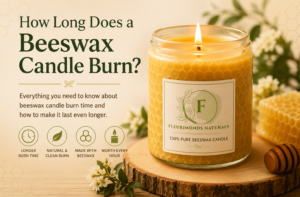
A general rule of thumb: beeswax burns roughly one hour per ounce of wax. So a 6-ounce candle gives you around 6 hours, a large 16-ounce jar can push past 100 hours, and a slim taper burns for a few hours depending on thickness.
Compared to soy and paraffin of the same size, beeswax simply lasts longer. That higher melting point means the wax turns to liquid more slowly, so the flame works its way through the candle at a gentle pace.
Here is a rough guide by candle type:
- Tea lights: 4 to 6 hours (versus 2 to 3 for paraffin)
- Votives: 12 to 15 hours
- Tapers (10-inch): 8 to 10 hours
- Pillars (3×4 inch): 60 to 80 hours
- Large jars (16 oz): 100+ hours
Those numbers are why people who care about the longest burning candles keep coming back to beeswax.
Why Beeswax Burns So Long
It comes down to chemistry. Beeswax has a melting point of around 145°F, noticeably higher than soy (around 120°F) or paraffin (around 130°F). A higher melting point means the wax resists turning to liquid, so it feeds the flame slowly and steadily instead of guttering away in a hurry.
There is a bonus here too. Because beeswax burns hot and clean, you get a bright, steady flame without the fast burn-down you would see on a cheaper candle. You are paying more upfront, but the beeswax candle’s burning time stretches the value back out over weeks instead of days.
What Actually Changes Your Burn Time
The numbers above assume you are treating the candle right. You are not always going to hit them, and here is why:
- The first burn matters most: Beeswax has a memory. The first time you light it, let it burn long enough for the melt pool to reach the edges of the container, usually one hour per inch of diameter. If your first burn is too short, you get tunneling, where the wick digs a hole straight down and wastes the wax around the sides.
- Wick size and quality: A wick that is too big burns through wax fast and smokes. Too small and it drowns. Well-made beeswax candles are wicked to match the wax, which is part of what you are paying for with a quality brand.
- Drafts: A candle sitting near an open window, a fan, or an AC vent flickers more, burns unevenly, and finishes faster. Keep it somewhere still.
- Trimming the Wick: Before every burn, trim the wick to about a quarter inch. A long wick creates a bigger flame that eats wax more quickly and throws soot. This one habit alone noticeably extends how long a candle lasts.
How Beeswax Stacks Up Against Soy and Paraffin
If burn time is your deciding factor, beeswax wins the matchup, and it is not close. Paraffin, made from petroleum, has the lowest melting point of the three and burns the fastest, which is part of why that cheap price tag stops looking cheap once you are replacing candles twice as often.
Soy lands in the middle. It’s plant-based and burns slower than paraffin, so you get more hours per dollar than the bargain stuff, just not as many as beeswax. We covered the full comparison in our guide on whether beeswax candles are better than soy or paraffin, worth a read if you are weighing all three.
So, in a straight burn time race, beeswax for durability, soy for balance, paraffin only if the budget is tight.
Getting the Most From Your Candle
A few simple habits protect that long burn time you paid for. Trim the wick before each light. Let the first burn form a full melt pool. Keep it away from drafts, and do not burn it for more than four hours at a stretch, since the wick can start to mushroom and burn less efficiently after that.
Do those things, and a good beeswax candle rewards you with clean, steady light for a very long time. For scent ideas that hold up over a long burn, browse our roundup of the top natural beeswax fragrances.
Ready to see the difference for yourself? Explore our handcrafted beeswax candle collection.
FAQ
What are the limitations of beeswax candles
Beeswax candles cost more due to labor-intensive production, offer a mild natural scent that limits fragrance options, and come in a narrow color range set entirely by the bees’ diet.
How long does a beeswax candle burn?
Roughly one hour per ounce of wax. A small 6-ounce candle burns for around 6 hours, while a large 16-ounce jar can last over 100 hours.
Why is my beeswax candle burning too fast?
Usually a draft, an untrimmed wick, or tunneling from a short first burn. Trim the wick, keep it away from airflow, and always let the first burn form a full melt pool.
Do beeswax candles burn longer than soy or paraffin?
Yes. Beeswax has the highest melting point of the three, so it burns slowest and outlasts same-size soy and paraffin candles.
Are beeswax candles the longest burning candles?
Among common waxes, yes. Their high melting point gives them the slowest, steadiest burn of the three.